


Titanium pipe VT1-0
Titanium pipe VT1-0
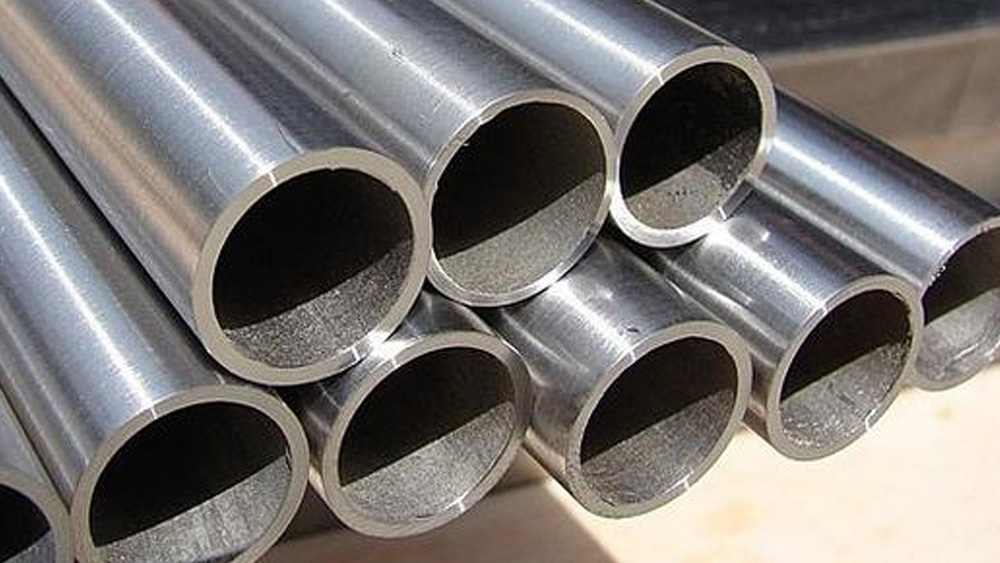
We offer seamless titanium pipes VT1-0 , cold-rolled, hot-rolled, or welded.
Advantages
Titanium pipes VT1-0 have a number of undeniable advantages compared to pipes made of ferrous metals:
- The low weight of the rolled product while maintaining high strength is precisely the quality for which this metal is sought after in the aerospace industry.
- Excellent heat and thermal shock resistance . Allows it to withstand very high temperatures. At the same time, the product does not undergo significant expansion, unlike other metals.
- High resistance to aggressive environments and oxidation.
- No response to magnetic fields.
Seamless titanium pipe VT1
Seamless pipes are undoubtedly the most popular type of rolled tubular products made from VT1 technical titanium. They are manufactured using a specialized, time-tested technology from a solid metal blank. Through various processing stages, the billet gradually takes the shape of a hollow core and is then rolled to the required dimensions.
There are two main types of seamless pipe: cold-rolled (cold-drawn) and hot-rolled. These two types differ significantly in terms of manufacturing technology.
Cold rolled
A distinctive feature of cold-formed products is that the workpiece is a hot-pressed titanium tube, and rolling occurs without significant thermal exposure. Titanium is inherently difficult to machine even under high heat, but without heat, working with it becomes even more challenging. Obviously, such complexities inevitably impact the price.
Why use cold-rolling technology if it's so complex and expensive? There are several possible answers:
- Firstly , due to the absence of thermal influence, there is no thermal deformation, making it much easier to finish the pipe to the required dimensions. This means that the precision of cold rolling is much higher than that of hot rolling.
- Secondly , the metal's properties change. It hardens, which inevitably leads to a decrease in ductility. Tensile strength, yield strength, and hardness increase, while elongation decreases.
This means the pipe is more precisely sized and stronger, which is especially important in the aviation industry, space industry, instrument making, and so on.
Hot rolled
Hot-rolled pipe VT1-0 is also produced on specialized machines, but unlike cold-rolled pipe, it is rolled using heat treatment. When heated, the metal becomes more ductile and easier to machine. However, this makes it more difficult to ensure consistent linear dimensions. After processing, the pipe inevitably cools, which means it will shrink. Thermal deformation is precisely the factor that hinders high manufacturing precision.
Welded
With welded pipes, things are a little simpler. First, slabs are taken and turned into titanium coils. The coils are cut into narrow strips. The strips are then twisted in a specific pattern, welded using a special welding process, annealed to impart the required properties, and then cut. The result is a welded pipe.
It's not as strong as seamless pipe. Argon arc welding is excellent, but even it can't achieve the same uniformity as seamless pipe. Because of its lower strength, welded pipe is not used in high-pressure systems.
Titanium VT1-0 technical
Titanium VT1-0 technical grade is used for pipe production . Its equivalent in the US is Grade 2 , in Germany it is DIN 3.7034 , and in England it is IMI125 . The chemical composition must comply with GOST 19807. This metal can be welded without restrictions, meaning no preheating or subsequent heat treatment is required.
A distinctive feature of this metal is its low specific gravity. For example, compare the weight of a VT1 pipe with that of a 12Kh18N10T stainless steel pipe. The stainless steel version will weigh almost twice as much! Furthermore, titanium has increased strength.